
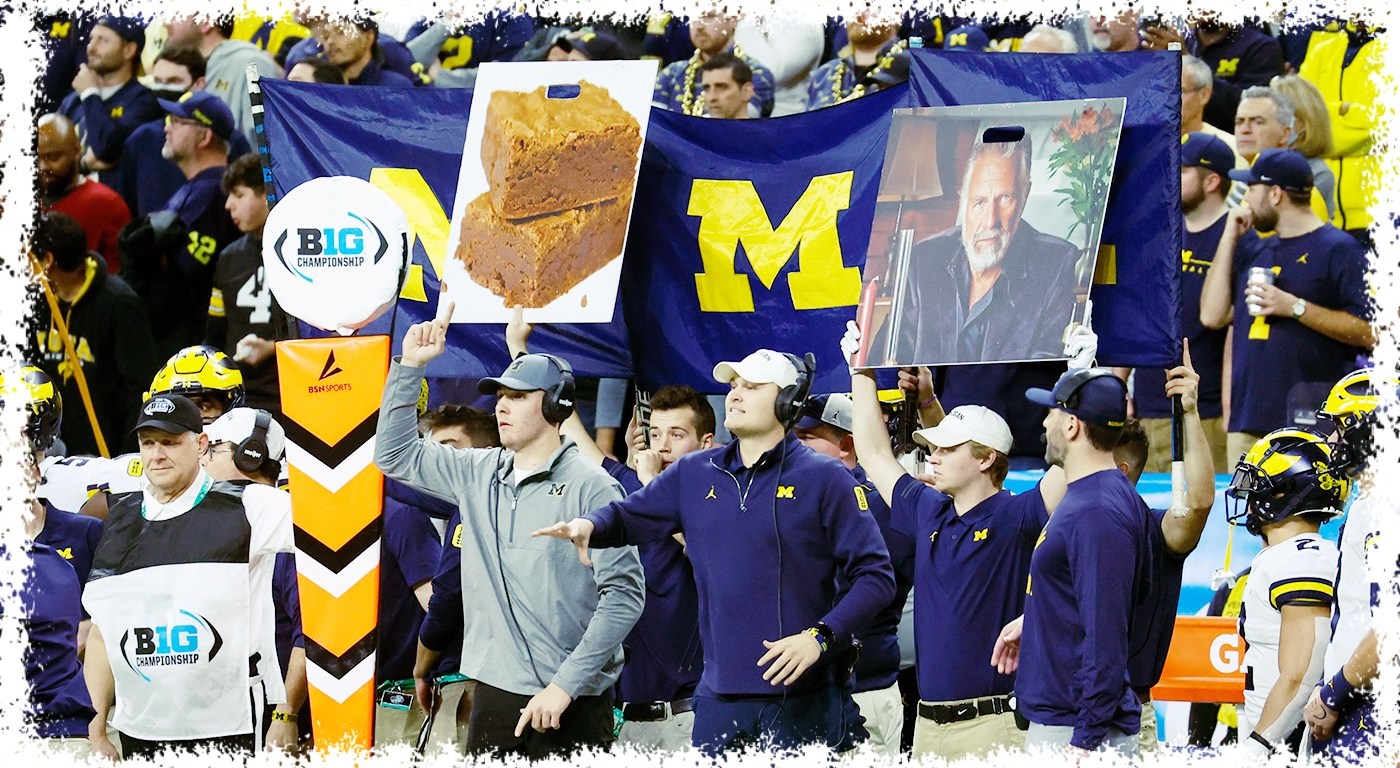
If at this point you do not know what happened at Michigan Football, you were living at a Buddhist retreat or you are a “Swiftie” where Taylor is the only thing that matters.
Anyway, it is worth recapping.
The NCAA started an investigation against Michigan for allegedly stealing opponents’ signs using methods banned by the governing body. While the investigation persists, Big Ten Coaches went “bananas” and asked for immediate action.
This led to, on November 10th, the NCAA announcing that it found Michigan violated the conference’s sportsmanship and used adjectives such as “pervasive” and “systematic” to impose a three-game suspension on Jim Harbaugh and the firing of Connor Stalions, the low-level staffer and “person of interest” to the NCAA who was directly responsible for the violation.
But the question this case seems to ignore is not if Michigan’s suspensions were the result of a structure that facilitated cheating but if this is another example of a tipping point that welcomes an evolution that should be recognized instead of being punished.
Nobody could have explained this better than a man who would have loved to have a glass of whiskey with the NCAA before the suspensions were delivered.
George Cassiday.
Follow me on this story.
On January 17, 1920, the US Congress passed The National Prohibition Act, and the country went dry enforcing the ban on alcohol.
At this time, Cassiday was serving in France in World War I where ironically troops constantly received cognac in their rations.
Upon his return, he failed the physical exam to return to his previous job and was forced to find other means to survive.
He found fortune when he became the official alcohol bootlegger for Congress.
Yes, he was the main distributor of alcohol of the people in charge of banning it. Hilarious.
In his words: “It may be a surprise and a shock to many good people to know that liquor has been ordered, delivered, and consumed right under the shadow of the Capitol dome ever since prohibition went into effect.”
On an average day, he would run between all 16 corridors in the House Office Building to deliver around 20 orders.
But one morning, caused by the discontent of some “dry” Congressmen, he was arrested and charged with alcohol possession and was put ninety days in jail.
Yes, he was punished by the same group that acted as customers. Again, hilarious.
Cassiday would go back to selling alcohol in the Capitol for five more years until he was finally sentenced to jail time in 1930 (he never actually spent the night in jail).
But three years later, in December 1933, the dry years came to an end when the 21st Amendment was ratified. Prohibition finished and with that, one of the most hypocritical laws this country has ever had.
Now, to understand how our rationality sometimes betrays us, we must go back to the motivations behind a rule.
Prohibition started as a method, proposed by women’s movements, for preventing abuse from alcoholic husbands.
Nevertheless, although the number of domestic violence cases was considerable at the time, they were not remotely comparable to the violence created by Prohibition.
Even worse, to this day there is no evidence that the ban on alcohol reduced domestic violence.
Technically, Cassiday violated the Law, but his behavior was an effect of a misplaced Law.
His actions were trying to claim the obvious, “Some of the senators and congressmen are hard workers who are busy from morning to night in committees or on the floor. When a day’s session is over, it is only natural for half a dozen of them to gather in one of the offices and enjoy a sociable round of drinks,” he wrote in one of his installments.
After all, Congress did not need to ban alcohol, it needed to evolve its perspective.
Today, after more than ninety years of being controlled and smartly regulated, revenue from alcohol tax amounts to 10.2 billion US dollars.
Sometimes, cheaters are more like teachers.
While the NCAA was busy imposing suspensions on Michigan, it was also reiterating that during this bowl season, teams will be allowed to use coach-to-player communication.
This “evolution” experiment, they say, is the result of a committee proposal to facilitate communication and take advantage of the use of technology (like instant replay) that has been available for almost thirty years.
Which committee made the proposal?
Of course, the Big Ten’s.
The same group that severely punished stealing signals, recognizes that they should have never been part of the game since many years ago.
In other words, this is the congressmen recognizing the irrationality of outlawing alcohol.
Notably, not all sign stealing is prohibited. It is allowed if it’s not done using electronics to relay information to players or coaches.
What is this? 1920? I cannot recall a day where I did not use an electronic to communicate.
Even funnier, programs cannot send anyone to scout a future opponent in person within the same season. In-person scouting of opponents has been outlawed since 1994.
Hilarious #3.
We have been using a thirty-year rule without further analysis of why it is there in the first place.
The rule was passed as a cost-cutting measure designed to promote equity for programs that could not afford to send scouts to other games.
According to federal tax records, the Big Ten Conference shared around 58.8 million dollars to each of its schools in 2022. Are you going to tell us that they do not have money to send scouts to the games? Business Class?
In the words of the great Vince Lombardi, “What the hell’s going on out here?”
Maybe two quotes resume this irony best.
“You can’t blame these men for taking the same means of refreshment and relaxation other people enjoy,” – George Cassiday.
«All of the Head Coaches in the Big Ten (some who have been accused of actively participating in the trading of signals of opponents) and my Big Ten AD colleagues can rejoice today that someone was ‘held accountable,’ but they should be worried about the new standard of judgment that has been unleashed in this conference,» – Michigan AD Warde Manuel.
Both men trying to express the same.
It is not the cheater who we should all be paying attention to, but the moment in history that his actions represent.
An evident termination of a rule that, due to our laziness in thought and lack of evolution, remained active long enough just to prove to be ridiculous.
 RedDeep